Why Fundraising Can't Live in a Silo (And What to Do About It)
Silos suppress fundraising.
Fundraising, while a specialized skill, is an all-in sport. We can't do it without you — yes, YOU: admin assistant, programs manager, board chair, bookkeeper, and marketing coordinator.
I feel the "nope" coming from every nonprofit soul already juggling a 1.5 FTE workload, and I'm sorry, but it's true. That's nonprofit life, baby. But I can offer you some relief: while accepting this premise will help your fundraisers do their jobs, it should not add to non-fundraisers' responsibilities. It's all about stepping outside the silos, building systems for sharing, and having open, frequent conversations about how our roles are connected.
Fundraising works best when everyone is part of it
A systems-first, purpose-centred approach means fundraising is more than just the "ask." The art and science of fundraising doesn't consist of a single point of requesting support — it starts and loops back around in a cycle of relationship-building-and-keeping activities meant to prepare for, and improve the success of, that moment when you say:
"This is what we are doing. Do you want to help?"
The image below is the Donor Journey Framework I use to help small nonprofits build holistic fundraising programs. It aligns with the classic fundraising cycle (identification, qualification, cultivation, solicitation, stewardship) but better represents what it's actually like to do fundraising in a small nonprofit where everything is closely connected.
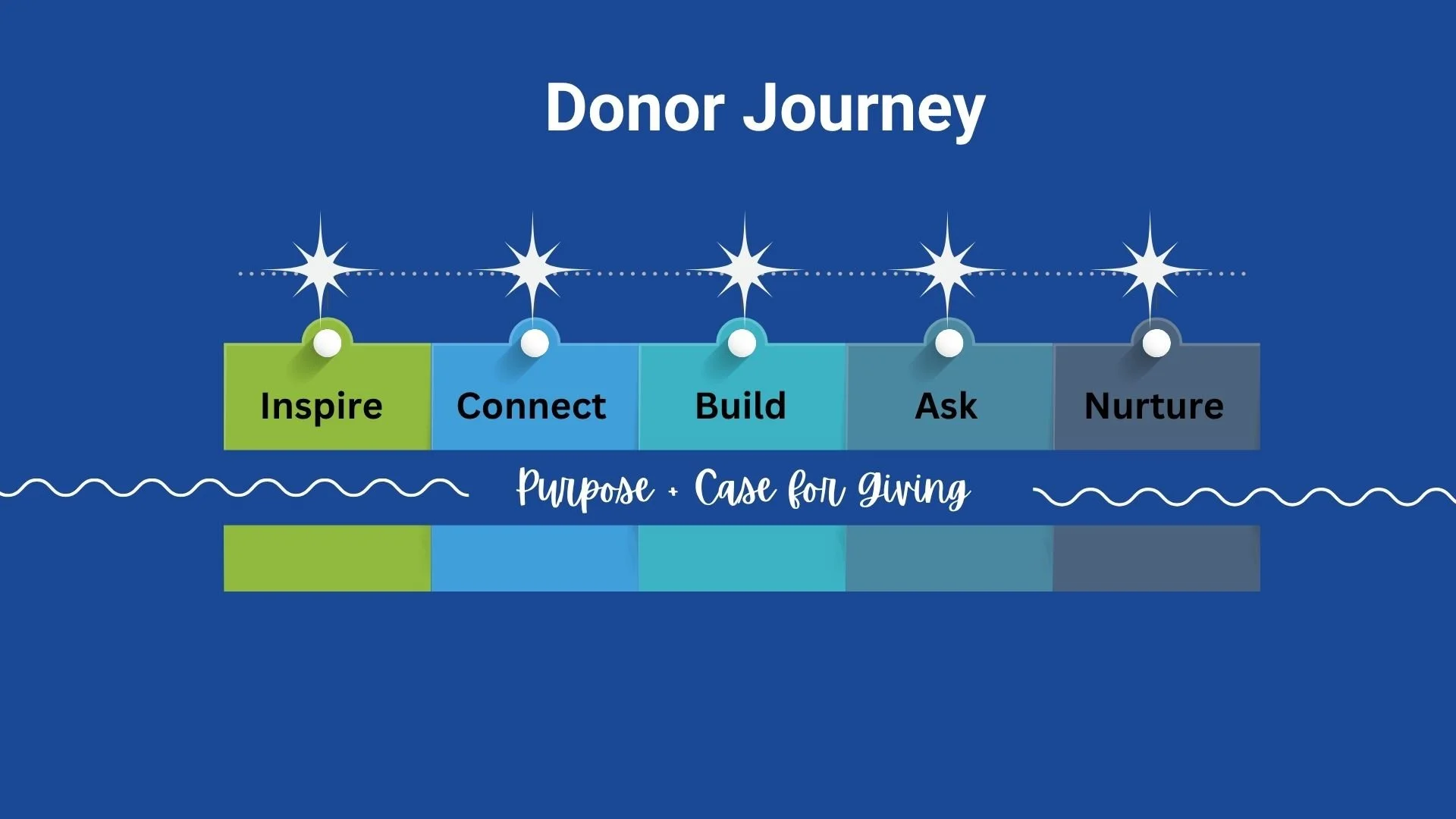
The Donor Journey Framework shows how a theoretical supporter might move through the system, how the relationship is built and kept, and how a variety of nonprofit roles support revenue generation for a cause.
I've written on each of these stages more in depth [here], and have a Donor Journey Framework worksheet available [here].
Briefly:
Inspire — the awareness-building stage. This is how we reach a broad audience to answer key questions: What is the problem we're solving? How are we solving it? How can you help? The goal is to signal and attract "our people" — those seeking to support a mission like ours. Connected roles: marketing, website management, outreach, communications
Connect — the tech stack stage. How are you getting "your people" into "your system"? The business owner your vice chair met at a networking event last week? The 50 people who signed up for your newsletter via clipboard at the last community festival? Connected roles: administration, IT/systems management
Build — the getting-to-know-you stage. Here we invite our people further into the circle by sharing information about our organization and mission, providing opportunities to get involved, and connecting with them — in person, over the phone, and through email. This is where we invite them to share their experiences, ideas, and observations. Connected roles: volunteer management, events coordination, program staff
Ask — ask strategically, ask consistently. Ask the right people, at the right time, for the right things. The first three stages have laid the foundation, and now we can invite support from our people. Connected roles: fundraisers, leadership, board members
Nurture — the keep-'em-in-the-loop stage. Continue to build and strengthen relationships by sharing impact and stories. Connected roles: program staff (to capture impact and track key metrics), communications (to share stories)
At every stage, we ask: how do we tell our story?
Running through the core of the framework is our purpose (Why do we exist?) and case for giving (What are we doing and how can you help?).
The answers to these questions influence every single strategy and activity throughout the Donor Journey Framework.
Everyone connected to and responsible for these activities can turn to the purpose and case for giving as their North Star. It guides their words and decisions. Purpose is their boss just as much as the fundraiser's.
A systems-first, purpose-centred approach is holistic — and it builds a better fundraising program. That means higher donor retention, more unrestricted revenue, the best chance for impact growth, the ability to attract and retain talented staff through competitive wages, and overall organizational resiliency.
Next month, I'm excited to explore how we go from purpose to plan – moving from purpose conversations to building the most important fundraising system of all: the 12-month fundraising plan.
Thanks for reading…
My name is Kim Peterson and I am a fundraising consultant. I help non-profits establish and scale-up individual giving programs, by building fundraising strategies and systems for growth and long-term stability.
I write about topics like this in my newsletter, “Fundraising from the Ground Up” so if you like what’s here ☝️, subscribe here
Follow me or connect on:
Learn more about my consulting services and how we can work together here.