Stop Losing Volunteers to Your Inbox: A Five-Table Airtable Base for Small Nonprofits
Volunteers are philanthropists too, so why is it that we don't hold their data as carefully as we do our donors'?
It isn't a lack of appreciation. The tools we use to track donor information often treat volunteer data as an afterthought, and small nonprofits end up duct-taping the gap with spreadsheets and Google Forms.
This is the next entry in my Systems-First series, and it walks through how I use Airtable for volunteer management in a real nonprofit scenario. The org, the mess, the five-table base, and why this kind of build matters when one person can't be the keeper of the whole program.
Problem: a volunteer program held together by one person
The org is a small environmental nonprofit. 5 full-time staff, 10 seasonal. Conservation and education programs run in parallel. Volunteers are spread across every program, and program staff manage their own volunteers.
Volunteer data lives in a collection of spreadsheets: one per program, one per year, none of them connected. The recruitment pipeline depends on whoever picks up the email. Hours tracking depends on program managers remembering to log them. One staff member holds most of it together.
Everyone wonders: what happens if she leaves?
Three active pain points
The three pain points showing up over and over in this kind of setup:
Interested volunteers fall through the cracks because no one is tracking the follow-up.
Hours data is too unreliable to report to funders with confidence.
There's no central view of who is active, trained, waivered, and ready to clean beaches.
According to Imagine Canada, volunteer time represents billions of dollars in contributed value to the Canadian charitable sector every year. We love our volunteers, but often the systems that are sold to us aren’t built to give their data a happy home. This is why so often the hours and the love fall into a janky spreadsheet that’s buried on program coordinator Sue’s desktop (somewhere…)
What a volunteer management system for nonprofits needs to do
A working volunteer management system for nonprofits has five jobs:
Track volunteers from first inquiry through to active status, with a pipeline that shows who needs follow-up
Log hours by volunteer, by shift, and by program, so reports pull from real data
Record orientation completion, waiver status, and emergency contacts in one place
Give program managers a way to log hours for their own teams without full database access
Let volunteers self-report their own hours after each shift
Solution: a custom five-table Airtable base
The build is a custom five-table Airtable base: Volunteers, Programs, Shifts, Shift Logs, and Inquiries. Each table holds one kind of information. Links between them mean hours tally automatically, program totals calculate in real time, and nothing gets re-entered or patched together from multiple sources.
Where recruitment lives
The Inquiries table is where recruitment lives. Every expression of interest lands here, with status tracked from New through Contacted to In-training and Active. The coordinator can see at a glance who needs a follow-up and who is already on the ground.
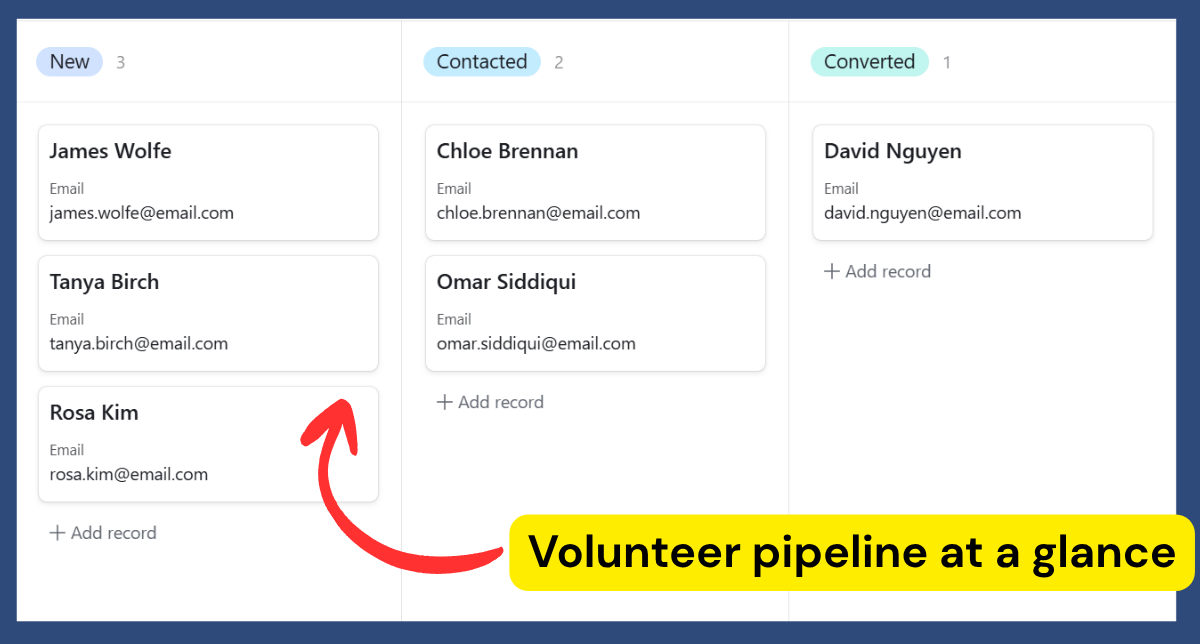
Volunteer pipeline at a glance: see who is new, contacted, and converted without digging through email.
How hours get tracked
The Shift Log is where we track hours, because support at this org isn't just counted in dollars. Volunteers submit their own hours through a shared form link sent after each shift. Program managers have a separate form for logging hours on behalf of their teams. That second form includes a flag for high school work experience students, so those hours can be reported separately when the school district asks.
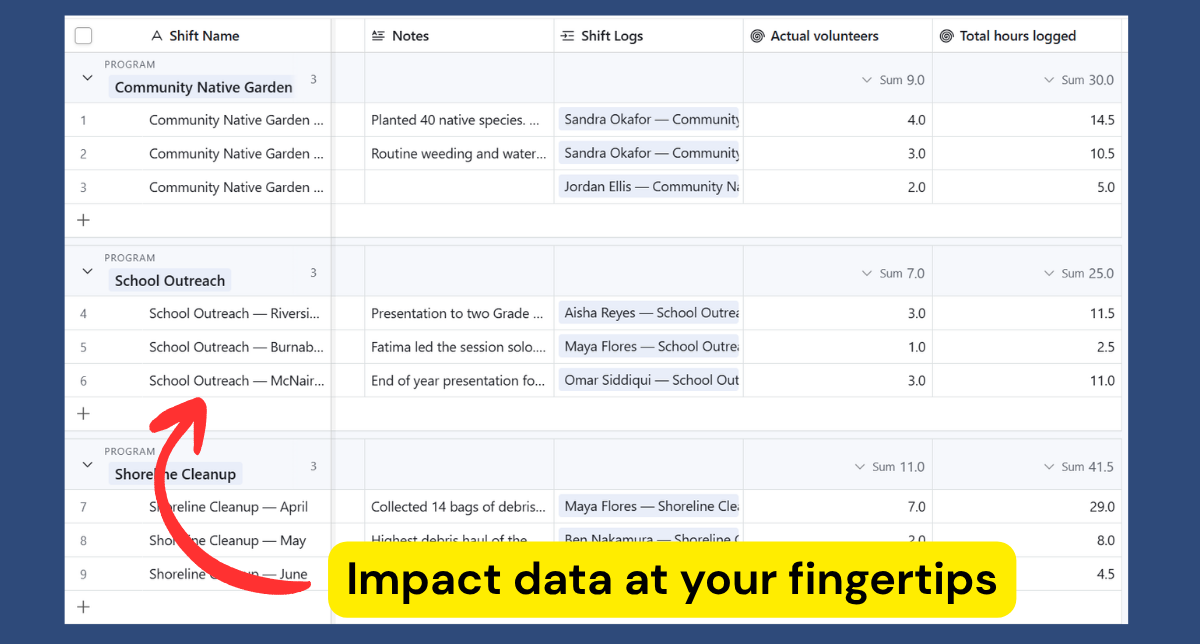
Impact data at your fingertips: volunteer hours organized by shift, program, and total contribution.
Compliance, continuity, and the appreciation picnic
The Volunteers table carries everything that matters for compliance and continuity: orientation completion, waiver status, emergency contacts, plus a running total of lifetime hours for the annual volunteer appreciation picnic.
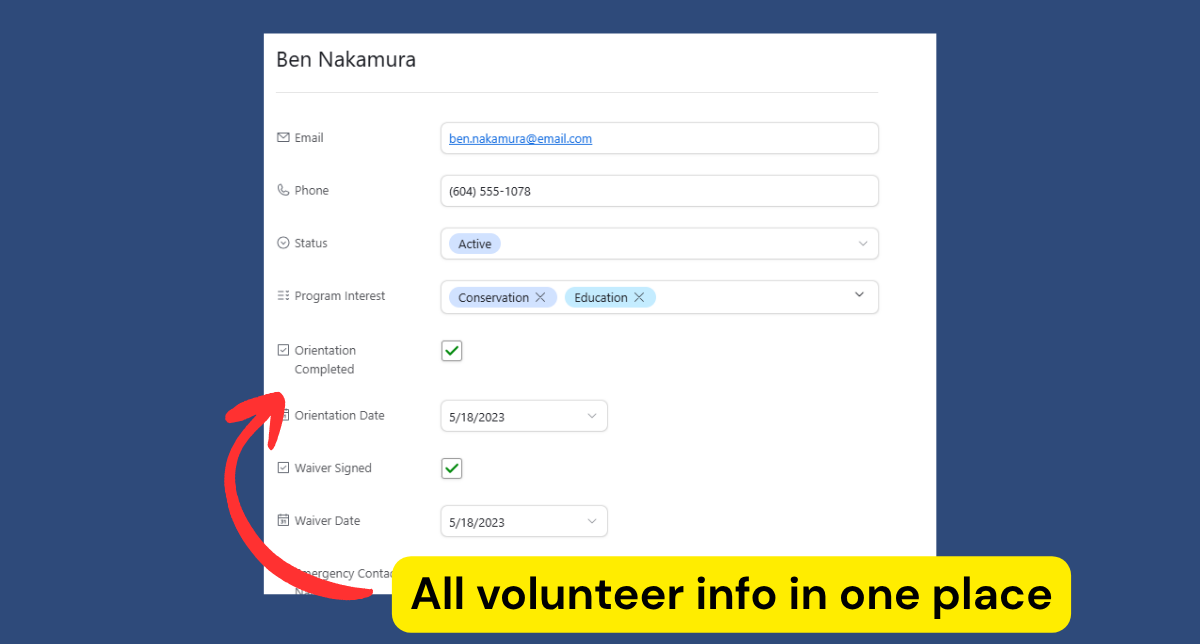
All volunteer info in one place: status, orientation, waivers, emergency contacts, and program interests.
The real value: the information stops belonging to one person
This is the same payoff as the grant management system I walked through last month. When the information stops belonging to one person, it belongs to the organization.
A new team member can open the base and understand the full state of the volunteer program in an afternoon. A funder asks for total hours by program. That's a filtered view available at a glance, not a three-hour spreadsheet project. The team member who's been carrying this in her head goes on vacation, and nothing breaks.
This is what Systems-First Fundraising looks like in practice for volunteer engagement. The same principle that the Association of Fundraising Professionals advances around donor stewardship applies just as cleanly to volunteers.